
Synthetic ETFs: The Complete Guide
Synthetic ETFs can provide investors with higher investment returns than physical ETFs. They can incur lower tax costs and track indexes with better accuracy. However, extra factors like counterparty risk, collateral and swap spreads make them more complex to understand.
Reading time: 17 min


Written by:
Dan Malone
What Are Synthetic Exchange-Traded Funds (ETFs)?
A synthetic exchange-traded fund (ETF) replicates the performance of an index using derivative contracts known as total return swaps, rather than directly purchasing shares in companies.
Synthetic ETFs vs. Physical ETFs
Synthetic ETFs are the opposite of physical ETFs, which purchase shares in companies tracked by a benchmark index. The shares are held in the same proportions as their weightings within the index. This is the traditional way that ETFs operate. Physical ETFs use two main replication methods or strategies when buying shares:
- 1
Full Replication: This is where the exchange-traded fund owns company shares in the exact same weighting as the index. All major physical S&P 500 ETFs use full replication.
- 2
Optimised Sampling: This is where quantitative models are used to select and invest in a representative subset of an index. Company shares will be excluded from the sample if their costs of ownership exceeds any potential benefits. Many All-World ETFs use optimised sampling.
Key Insight: Physical ETFs are much more common than synthetic ETFs. It’s estimated that 88% of available UCITS ETFs are physical.
Structure
The classifications of physical and synthetic refer to an ETF’s structure. The structure tells investors how the fund is created and operated on a day-to-day basis. Both physical and synthetic ETFs share a common goal, to provide investors with the index return, but they go about achieving it in different ways.
How Do Synthetic ETFs Work?
Synthetic ETFs provide the index return without physically owning shares in companies that are tracked by an index. This is made possible through the use of financial derivatives known as swaps, specifically a Total Return Swap (TRS). This is a contract between two or more parties where both parties agree to swap the total returns of two separate baskets of securities with one another.
Total Return Swaps (TRS) Explained: Let’s say that Party A is a synthetic ETF, which enters into a TRS with Party B, which is an investment bank like Société Générale. In this arrangement, Société Générale can be described as the synthetic ETF’s counterparty.
The counterparty promises to pay Party A the total return of an index, like the S&P 500. In return, Party A promises to pay the total return of a specified basket of securities, plus a fee. Total return in the case of stocks equals the sum total of share price increases and dividends paid.
If you were to buy shares in the synthetic ETF, you would receive the index return. That’s because the counterparty has contracted to pay the total return of the S&P 500.

Free Weekly Update
Free Weekly Update
Clear, practical insights on savings, pensions, banking, insurance, tax, and more.
Types Of Total Return Swaps
There are two types of total return swaps that a synthetic ETF can use to provide its investors with the index return.
Unfunded Total Return Swaps
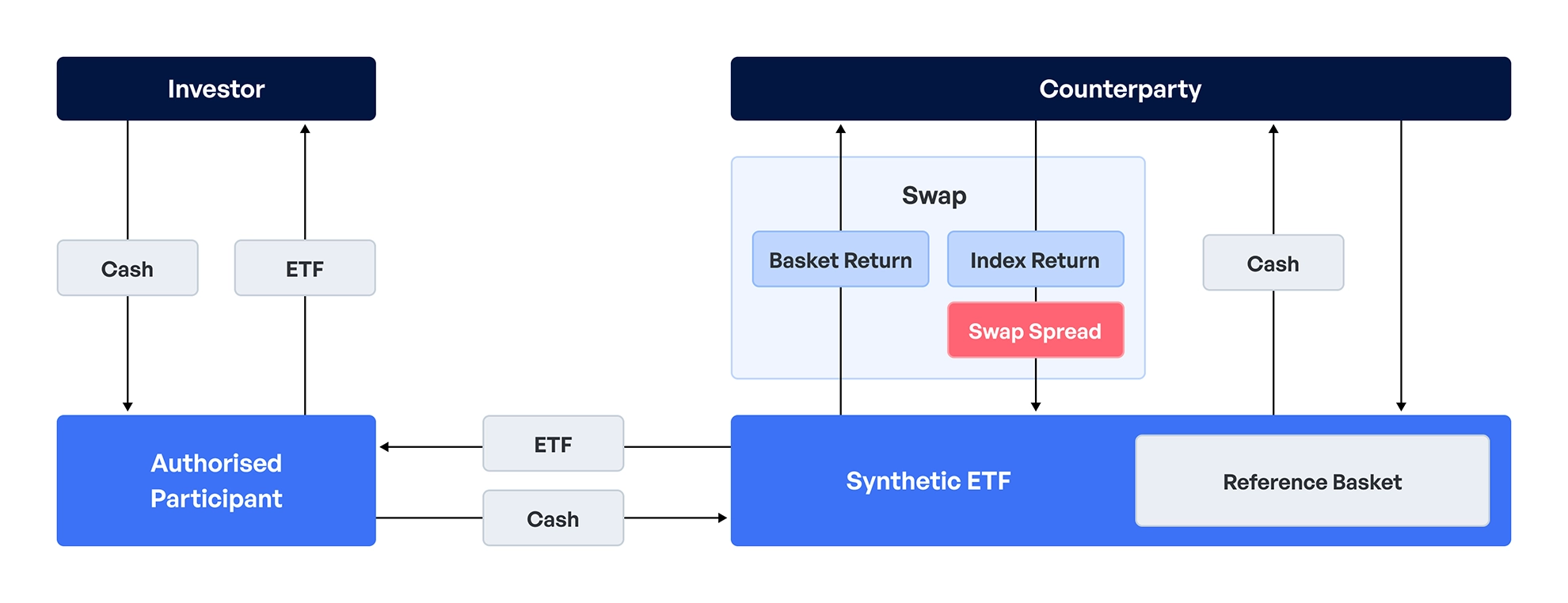
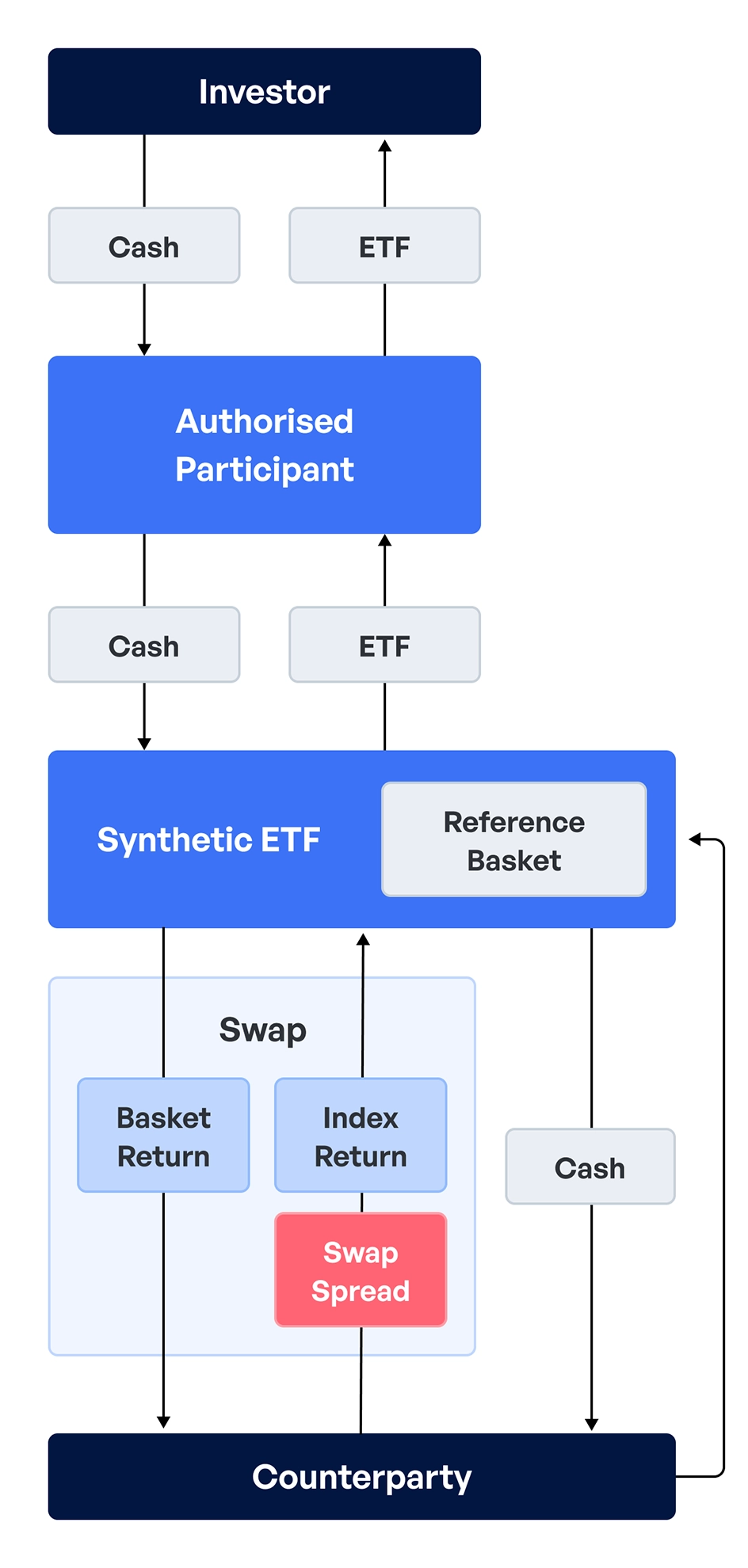
Unfunded total return swaps are the most common swap arrangement used by synthetic ETFs. Here’s how they work:
Step 1: The synthetic ETF arranges with one or many counterparties for the index return to be paid to the ETF. Common counterparties include Goldman Sachs, Morgan Stanley, JP Morgan, Barclays and Citigroup.
Step 2: The counterparty instructs the ETF to purchase a basket of securities, typically from the counterparty itself. This basket could be made up of a wide variety of stocks or other assets. The fund will use investor money to purchase the basket of securities from the counterparty. The purpose of the basket is to act as collateral.
Counterparty Risk: If the counterparty defaults on its obligations and fails to pay the index return to the exchange-traded fund, the ETF can claim the basket of securities to protect its investors against losses. That’s the purpose of collateral. The risk of a counterparty failing to pay the index return is known as counterparty risk.
Step 3: The ETF pays the total return of the basket of securities to the counterparty. The counterparty pays the index return to the ETF, plus a swap spread.
Swap Spread: This is the difference between the fee the fund pays on the index return and the fee it receives on the basket return. It can be positive, which means the ETF pays a swap fee, or negative, where the ETF earns an additional return. Negative swap spreads can allow a synthetic ETF to outperform the index, provided they exceed the total expense ratio (TER).
Funded Total Return Swaps
With a funded total return swap, the synthetic ETF does not pay the counterparty the total return of a basket of securities held as collateral.
The counterparty receives cash from the ETF and it uses that cash to purchase a basket of securities as collateral. Instead of the ETF holding the collateral, the collateral is held with an independent third party known as a custodian.
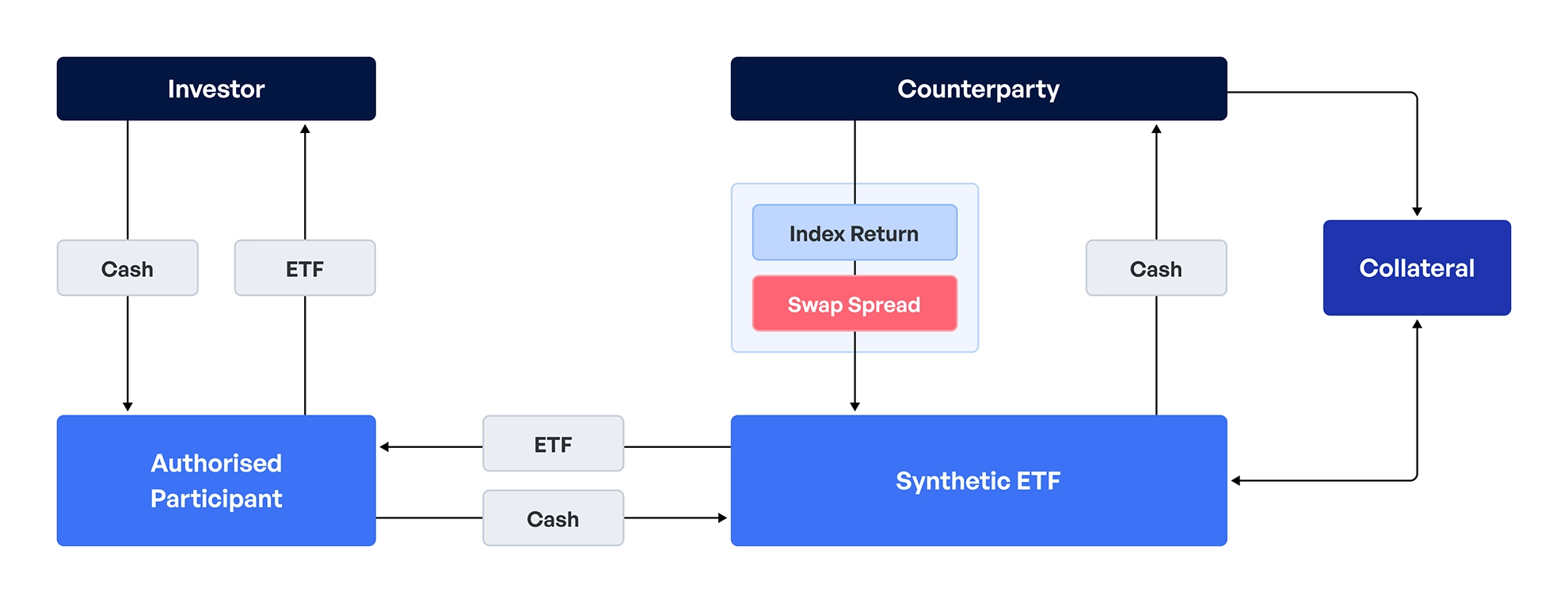
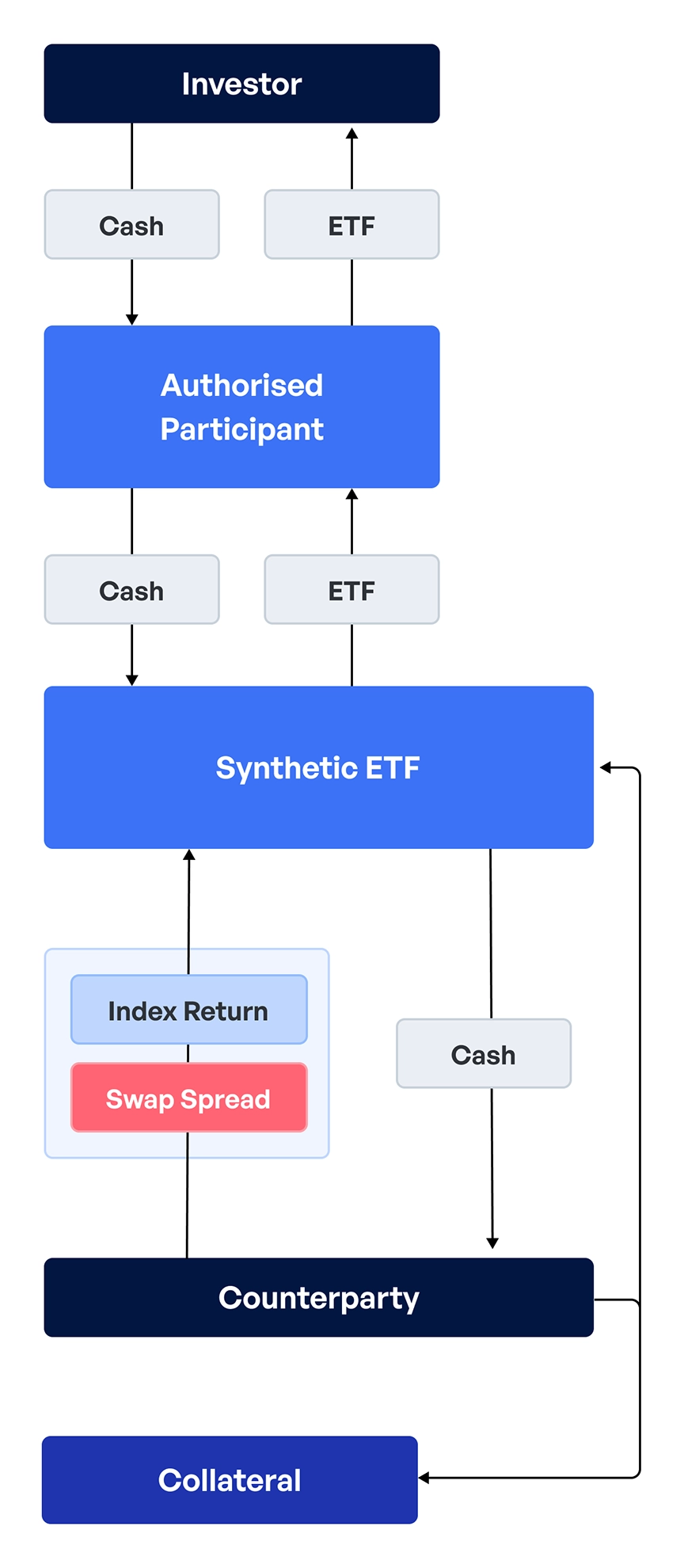
If the counterparty defaults, one of two things can happen:
1. Transfer of Title Arrangement
If the collateral is held with the custodian under a transfer of title arrangement then the collateral will move from the custodian’s account to the ETFs account and the fund can claim the collateral to protect its investors against losses.
2. Pledge Agreement
If the collateral is held with the custodian under a pledge agreement then the collateral will be placed into a pledged account in the name of the counterparty. That means the ETF won’t have direct access to the basket of securities.
Why Investors Choose Synthetic ETFs
There are a number of benefits of synthetic ETFs over physical ETFs.
One of the most popular use-cases for synthetic ETFs is the removal of U.S. Dividend Withholding Tax (DWHT). s871(m) of the U.S Internal Revenue Code explicitly exempts swaps, which provide the total return of a qualified index from U.S. DWHT. An index must satisfy specific criteria to be considered a qualified index, but common examples include the S&P 500, MSCI World and Russell 1000 indexes.
When an Irish domiciled physical ETF receives dividends from U.S. companies, there’s an obligation for 15% of the total dividend to be withheld from the ETF and paid over to the IRS. That means for every $1 of dividends paid to the physical ETF, it actually only receives $0.85. With synthetic ETFs, 100% of the dividend would be available to the ETF. There would be no withholding tax paid to the IRS.
This means that synthetic ETFs can provide investors with the gross return of the S&P 500 index, in other words, the pre-tax total return of both capital gains and dividends arising from S&P 500 company stocks. Synthetic S&P 500 ETFs should provide higher returns than physical S&P 500 ETFs, all else being equal.
Key Insight: A qualified index will not have a dividend yield that is more than 1.5 times the annual dividend yield of the S&P 500 index. This ensures that you can’t invest a synthetic ETF that tracks a high dividend yield index to avoid dividend withholding tax.
The tax benefits aren’t just restricted to S&P 500 ETFs. Synthetic ETFs tracking indexes that contain UK stocks would avoid UK stamp duty. For French, Italian and Spanish stocks, a financial transaction tax (FTT) would be avoided. Synthetic ETFs tracking an all-world index could benefit from all of these tax advantages simultaneously.
The other advantage of synthetic ETFs is a reduction in tracking errors. A tracking error occurs when an ETF’s return inconsistently differs from the return of its target index. As an index fund investor, you want to receive the return of the index. When you’re invested in a fund that experiences tracking errors, your investment return will shift from the true return of the index, for better or worse.
Many physical ETFs use optimised sampling strategies to provide investors with the return of an all-world index. While sampling is useful for optimising cost-benefit analysis, it can also increase the likelihood and magnitude of tracking errors. Because the physical ETF is excluding or substituting certain companies from the fund, it becomes more likely that the ETF’s performance will deviate from the index.
Key Insight: With synthetic ETFs, because the counterparty is paying the total return of the index to the ETF, there should be fewer tracking errors. This can provide investors with a more accurate index return.
Disadvantages Of Synthetic ETFs
The biggest disadvantage of synthetic ETFs is the additional research that’s required to understand the quality of counterparties, the quality of collateral and the level of collateralisation. This makes them unsuitable for beginners.
The most well-known, but also the most misunderstood, ‘disadvantage’ of investing in synthetic ETFs is counterparty risk. In reality, the existence of counterparty risk isn’t so much a disadvantage as it is a feature.
Counterparty risk is the risk that the ETF’s counterparty will default on its obligations to pay the index return. The quality of an ETF’s counterparties matters and is a genuine consideration that needs to be taken into account. Ideally, there will be more than one counterparty to limit the potential impact of any one counterparty’s failure.
There’s a common misconception that if the counterparty fails, your investment in the synthetic ETF will go to zero. In most cases, that’s not true. That’s what the collateral is for.
Key Insight: Physical ETFs have counterparty risk too! Most of these funds engage in securities lending to earn additional revenue. This is where the fund lends out its investments to 3rd parties in exchange for a fee. The borrower is the counterparty and the risk is that they may not return the shares to the ETF. This risk is managed through collateral.
With unfunded total return swaps, the ETF holds a basket of securities as collateral. This differs from funded total return swaps, where collateral is held with an independent custodian. In both cases, the collateral is there to protect investor returns in the event of a counterparty failure. Because of this, the quality of the collateral that is posted is very important.
What Is Good Quality Collateral?
In simple terms, we can think of quality as reliability. Here are some questions you can ask to assess the quality of collateral:
1. Is the collateral made up of blue-chip stocks like Apple, Coca Cola and Microsoft, or is it made up of more volatile and speculative holdings?
A synthetic S&P 500 ETF investor would want the collateral posted to align somewhat with the risk and return profile of the S&P 500 index. You wouldn’t want to be in a situation where the counterparty defaults and your collateral is made up of meme stocks and cryptocurrencies. Fortunately, such extreme discrepancies aren’t possible under UCITS regulations.
2. Is the collateral made up of liquid securities? Will the ETF be able to sell the collateral in a falling market without having to take any material sacrifices on price?
The more illiquid the collateral and the greater the misalignment between the collateral basket and the index, the more risk there is for synthetic ETF investors.
Collateralisation Levels
You also have to consider the level of collateralisation. What’s the value of the collateral posted relative to the net asset value (NAV) of the synthetic ETF? If the fund has a net asset value of $10M and the collateral posted is $9M, then the collateralisation would be 90%.
In other words, the current market value of the collateral posted would cover 90% of the investor’s loss in the event of the counterparty’s failure. It is in the best interest of synthetic ETF investors for the collateralisation to be as close to 100% as possible. Many synthetic ETFs are overcollateralised (i.e. above 100%), which is good for investors.
Key Insight: EU regulation states that the difference between the market value of the collateral posted and the net asset value of the ETF cannot exceed 10%. If the difference goes above 10%, then the counterparty will transfer additional collateral to the basket to bring the collateralisation up to the minimum threshold of 90%.
Does The Data Support Synthetic ETFs?
Dividend Withholding Tax
The dividend withholding tax exemption adds ~0.30% worth of performance per annum vs. the S&P 500 NTR index. This is calculated as the S&P 500 Dividend Yield x 30% DWHT.
Total Expense Ratio (TER)
Passive synthetic ETFs tracking broad based indexes tend to have TERs that are either best-in-class or closely aligned with physical ETFs.
Tracking Errors & Tracking Differences
Synthetic ETFs have lower tracking errors on average, but tracking differences can vary due to swap spreads.
Collateral Risk & Return Profiles
The number and concentration of holdings in the collateral basket can lead to differences in risk and return profiles versus the index.
Collateralisation
Collateralisation requirements may be lower if the fund manager and swap counterparty are affiliated. EU regulation prevents collateralisation from falling below 90%.
Popularity
Assets Under Management (AUM) of Synthetic ETFs in Europe has been trending upwards since 2020.
Are Synthetic ETFs Best for Irish Investors?
Synthetic ETFs are more complex than physical ETFs. However, synthetic ETFs can outperform their physical counterparts, making them a competitive option for Irish investors willing to do the initial research. Any outperformance will depend on:
- 1The total expense ratio (TER) differential.
- 2The swap spread and whether it’s positive or negative.
- 3Any additional revenue streams earned by the ETFs.
The biggest drawback of synthetic ETFs is the extra due diligence that’s required before investing.
- Knowing how many counterparties there are.
- Determining whether the ETF is affiliated with the counterparties.
- Finding the average level of collateralisation.
- Assessing the risk and return profile of the collateral basket.
- Researching the current and historical swap spread.
These are all factors that must be considered. To make matters more complex, not all synthetic ETFs will be forthcoming and transparent with all of the facts necessary to make a fully informed decision. The fund fact sheet and the ETF provider’s website would be good places to start for researching.
Did You Know?: Invesco is one of the most transparent providers of synthetic ETFs. They disclose swap fees, collateral basket holdings and counterparty exposure among other key information.
Key Insight: Synthetic ETFs are misunderstood investment products that can be suitable alternatives to physical ETFs. However, there’s no question that they are inherently complicated and come with more risk factors than physical ETFs.
10 Questions To Answer Before Investing In A Synthetic ETF
Before investing in a synthetic ETF, you should ideally be able to answer the following questions:
- 1What is the total expense ratio (TER) and how competitive is it relative to other synthetic ETFs?
- 2Who are the counterparties to the total return swap (TRS)?
- 3Are there any conflicts of interest between the ETF provider and the counterparties to the TRS?
- 4How much is the TRS fee?
- 5What is the current and historical swap spread?
- 6Is the collateral basket liquid and aligned with your attitude towards and tolerance for risk?
- 7Are the constituents of the collateral basket listed on the ETF provider’s website?
- 8What is the target and current collateralisation level?
- 9If a counterparty defaults, what is the process for appointing a new counterparty?
- 10If a funded TRS is being used, what is the process for gaining access to the collateral held by the custodian if a counterparty defaults?
Frequently Asked Questions
A swap fee is the cost to the counterparty of providing the index return, including the cost of hedging their obligations to the ETF. The counterparty can hedge by buying the underlying shares of the index, which comes at a cost.
It depends on the ETF. For those that track broad based indexes, we’ve noted swap fees ranging from between 0% - 0.50%.
Without a hedge, the counterparty would be exposed to market risk. If the index rises by 20%, they owe the ETF that return. The counterparty is ‘short’ the index and ‘long’ the basket.
Swap spreads are calculated by counterparties using assumptions around dividend yields, hedging costs, and risk. They can be positive or negative depending on how the assumptions align with the index. Swap spreads are notoriously opaque and difficult to predict.
A negative swap spread arises when the counterparty’s cost of providing the index return is lower than expected. This may result from tax efficiencies, valuable collateral, hedging efficiencies and competition between swap providers.
Most synthetic S&P 500 ETFs are benchmarked against the S&P 500 Net Total Return (NTR) index, which accounts for U.S Dividend Withholding Tax (DWHT) at 30%. DWHT doesn’t apply to synthetic S&P 500 ETFs. The counterparty passes on the gross return. There’s also cost savings for the counterparty if the fund holds the hedge as part of the collateral basket.
No, provided dividend yields turn out as expected. If the swap is based on the net index and dividend yields are higher than expected, the counterparty is at an advantage. If it’s based on the gross index and yields are higher than anticipated, the ETF is at an advantage.
Because any outperformance generated by the total return swap would be negated if the collateral basket was the same as the index. It’s like with securities lending. The benefit of securities lending for physical ETFs would be lost if the collateral received by the fund was identical or similar to the securities lent.
Securities lending of Chinese shares is heavily restricted, creating demand for short contracts to manage risk. Investment banks need a supply of China-A shares to safely sell the contracts. Synthetic ETFs hold these shares in the collateral basket. The counterparty pays a premium to the ETF to access the shares, leading to a boost for the fund.
No, the counterparty doesn't invest on behalf of the ETF. Rather, the counterparty pays over the total return of the index in cash. That’s why most counterparties to synthetic ETFs are cash rich investment banks.
No, both synthetic and physical exchange-traded funds can be set up as accumulating ETFs. Accumulating ETFs automatically reinvest any dividends that they receive. This helps Irish investors to avoid income tax on distributions. But they aren't specific to synthetic ETFs.
The fund. It’s the ETF, not the investor, who incurs dividend withholding tax. This happens when an ETF receives a dividend from the companies that it invests in. s871(m) of the U.S. Internal Revenue Code exempts the likes of synthetic S&P 500 ETFs, who use total return swaps, from U.S. dividend withholding tax.
ETFs domiciled in Ireland and Luxembourg, which are the two most common in Europe, are not required to withhold tax on dividends paid from the fund to the investor.
No, this is a sensationalistic explanation of counterparty risk. Synthetic ETFs can have multiple counterparties. The risk is spread across all counterparties, albeit unevenly. Even if one counterparty defaults, the ETF would claim the collateral and find a new counterparty to provide the index return.
No, UCITS regulation states that the difference between the market value of the collateral posted and the net asset value of the ETF cannot exceed 10%. If the difference goes above 10%, then the counterparty will transfer additional collateral to the basket to bring the collateralisation up to the minimum threshold of 90%.
It depends on the ETF. While the risk and return profile of the collateral basket can be different to the stocks in the target index, in many cases it's not so different that the liquidity profiles are misaligned.
If there is a large inflow of redemptions from the ETF then it would sell securities in the collateral basket. The cash proceeds would then be used to repurchase ETF shares from the authorised participant (AP). Given that collateralisation levels often exceed 100% of NAV, the synthetic ETF would have just as much capacity to meet redemptions as physical ETFs.
No, physical ETFs can have counterparty risk too, for example, when they engage in securities lending to earn extra income for the fund and/or its investors. There’s a risk that the borrowing party (i.e. a short seller) will default on their obligations to return the borrowed assets.
Treasury Regulation §1.871-15 is the law that deals with the tax treatment of dividend equivalents, which covers dividends received by synthetic ETFs that provide the total return of a qualified index.
Compare ETFs Side by Side
Ready to choose an ETF? Compare the most popular ETFs available to Irish investors by index, fees, dividends, and more to find the right investment for your portfolio.