
ETFs: A Complete Guide
Exchange-traded funds (ETFs) have become one of the most popular ways to invest, thanks to their instant diversification, low fees, and simplicity. In this complete guide, we’ll explain what ETFs are, how they work, and how to start investing in them.
Reading time: 33 min


Written by:
Dan Malone
What Is An Exchange-Traded Fund (ETF)?
An exchange-traded fund, better known as an ETF, is a type of investment fund. An investment fund is a company whose business involves buying and selling financial assets for the benefit of its shareholders.
Investors buy and sell shares in ETFs on the stock market. That’s why it’s called an exchange-traded fund, because its shares are traded on a stock exchange.
Key Insight: When you buy shares in an ETF you become entitled to a percentage of:
- 1
What the fund owns; and- 2
What it will earn in the futureAn equity ETF can own hundreds, if not thousands, of company shares. When you invest in one, you get to own many different companies at once. Comparatively, shares in regular companies, like Apple, only let you own part of one business.
Types of ETFs
ETF types are classified by what they invest in:
An equity ETF invests in stocks. The companies that a fund owns can vary based on size, industry, environmental impact and whether they pay a dividend. To learn more about stocks, check out our complete guide.
A bond ETF invests in debt securities. This could be government bonds, corporate bonds, or a combination of both. The types of securities included in the fund’s portfolio will depend on the bond issuer, yield, credit rating, maturity, inflation-protection and coupon. Read more about bonds with our dedicated guide for Irish investors.
A commodity ETF provides exposure to commodities such as gold, silver, oil, or agricultural products.
A real estate ETF invests in shares of real estate companies and real estate investment trusts (REITs). These funds can provide exposure to residential, commercial, industrial, healthcare, and other property sectors across different regions.
A currency ETF provides exposure to the performance of one or more foreign currencies.
A money market ETF invests in high-quality, short-term debt securities. These may include government bonds, commercial paper, certificates of deposit, and other money market funds.
A multi-asset ETF invests in a combination of asset classes within a single fund, typically a mixture of equities, bonds, and cash equivalents.
A cryptocurrency ETF will invest in shares of companies involved in the digital asset industry, such as cryptocurrency exchanges, mining companies, and businesses that develop blockchain technology. UCITS regulations prohibit ETFs from owning cryptocurrencies directly.
An alternative asset ETF invests in assets outside traditional stocks and bonds, such as distressed assets or private equity.

Free Weekly Update
Free Weekly Update
Clear, practical insights on savings, pensions, banking, insurance, tax, and more.
Active vs. Passive Funds
There are two main investment strategies used by ETFs, which determine how the fund invests – active and passive.
Active ETFs
An actively managed ETF is run by a team of investment professionals who decide what the fund should buy, hold and sell. The fund manager selects investments with the aim of outperforming a specific benchmark.
Passive ETFs
A passively managed ETF invests with reference to a financial index. Its objective is to replicate the performance of the index by holding all, or a representative sample, of the assets that it contains.
Active ETFs generally have higher fees than passive ETFs. This may come in the form of a higher total expense ratio (TER), higher transaction costs, or, in some cases, performance fees. Fees and charges hurt investment returns, and even small differences in cost can have a significant impact on your portfolio over time. You can see this for yourself by using our fund fees calculator.
Key Insight: Investment professionals don’t have reliable ways of beating the market. As a result, most actively managed funds underperform their benchmark after fees over the long term.
Index Funds vs. ETFs
‘ETF’ refers to a fund’s legal structure, while ‘index fund’ describes its investment strategy. Not all index funds are ETFs, and not all ETFs are index funds. To fully understand index funds, you need to know what an index is.
What Is An Index?
Indexes, or indices, measure the performance of particular markets or groups of investments, like stocks or bonds. For example, an all-world equity index is a benchmark designed to measure the performance of global stocks from developed and emerging markets.
A stock market index is a tool used by investors to measure the stock performance of a particular collection of stocks. Groups of stocks are measured to see the bigger picture, beyond the performance of any individual company. The stocks that are chosen for measurement depends on the index.
The global stock market is massive. Shares are bought and sold by investors all around the world on stock exchanges like the New York Stock Exchange, NASDAQ, or London Stock Exchange. In fact, the OECD reported that there are approximately 52,000 publicly listed companies globally.
Imagine you wanted to know how global stocks were performing, or even the performance of a group of stocks from certain countries or industries. Looking at each stock individually and aggregating their performance would take a very long time. That’s where the stock market index comes in.
Indexes came about in 1896, with the creation of the Dow Jones Industrial Average (DJIA), an index which included 12 companies chosen to represent key areas of the U.S economy. The idea behind the Dow was simple, to give investors an easy way to assess the performance of the U.S stock market.
Today, the S&P 500 is the world’s most popular stock market index. It tracks the performance of 500 leading companies in the United States. Although it only includes 500 companies, they account for 80% of the total value of the U.S stock market – making it a good representation of the market as a whole. Investors can look at the price chart of the S&P 500 to get an idea of how U.S equities have performed over time.
But the S&P 500 is just one index that’s available to investors. Other examples include:
- FTSE 100: The 100 most valuable companies listed on the London Stock Exchange
- MSCI World: 85% of the total value of the stock market across 23 developed countries
- CBOE Volatility: Measures the expected volatility of the U.S stock market
Indexes come in all different shapes and sizes, each with their own purpose.
Key Insight: Investors can’t invest in an index, but they can invest in an index fund.
What Is An Index Fund?
An index fund is an ETF, or mutual fund, that aims to replicate the performance of an index for its investors. It’s an investment product that allows investors to earn an index’s return.
The first index fund was launched in 1975 by Vanguard, when they launched an investment fund tracking the S&P 500. The premise was simple: gather money from lots of different investors and use that money to invest in the stocks measured by the S&P 500 index.
Key Insight: Index funds are the ideal investment for most long-term investors. They provide exposure to the returns of hundreds, or even thousands, of companies through a single investment.
Imagine trying to achieve the same level of diversification without an index fund. You’d have to buy shares in every company included in the index. While fractional shares make this more achievable than it once was, it would still be inefficient in terms of time, cost and tax.
Index funds make investing easier too. There’s no need to do extensive research, beyond figuring out which fund is best for you – which is a vastly different experience from researching and selecting individual stocks. You can learn more about that in our complete guide to investing in stocks.
Above all else, low-cost index funds have historically outperformed the majority of actively managed funds over the long term. That’s why ordinary investors can, in theory, outperform professional fund managers.
How much of each stock an index fund buys is dictated by the weightings within the index.
Index Weighting
Index weighting decides how much the performance of each stock influences the overall return of an index. There are two common weighting methodologies.
In a market-capitalisation weighted index, the stock performance of the most valuable companies have the greatest impact on the index return. This is the most common approach used by equity indices.
Market capitalisation is the total perceived value of a company on the stock market. It’s calculated by multiplying a company’s share price by the number of floating shares. These are outstanding shares that are available for trading, excluding any locked-up or closely held shares.
A company’s percentage weighting within a market-cap weighted index is calculated as:
(Company Market Capitalisation ÷ Total Index Market Capitalisation) x 100 = Index Weighting
An index fund tracks these weightings by investing more in larger companies, and less in smaller companies. As share prices change, so too do weightings, and the fund will adjust its holdings to reflect the updated weights.
In an equal-weighted index, the performance of each stock has the same impact on the index return. Every company has the same weighting, regardless of its size. Index funds tracking an equal-weighted index require regular rebalancing to maintain equal weights.
Compared to market-cap weighted index funds, they have higher turnover, higher trading costs, and greater exposure to smaller companies.
Tracking Difference vs. Tracking Error
Index funds will not always provide investors with the exact return of the index. Fund expenses, taxes, income and inefficient replication can all cause differences. There are two ways these differences are measured.
Tracking Difference: The difference between the fund’s return and the index’s return.
Tracking Error: How consistently the fund tracks the index over time.
ETFs vs. Mutual Funds
A mutual fund, like an ETF, is an investment fund. It’s a pool of money collected from many different investors with the goal of investing in a wide range of financial assets. Unlike ETFs, you can’t invest in mutual funds through a stock exchange. You have to buy shares directly with the investment manager who is offering the fund.
The price of mutual fund shares are determined once, at the end of the trading day, with reference to the net asset value (NAV) of the fund. This is different from ETF share prices which are constantly updating.
You can invest in ETFs with as little as €1 on most investment apps, but a mutual fund typically requires a minimum investment of hundreds or thousands of euros. This makes them less accessible to the average investor.
ETFs also tend to have lower total expense ratios (TERs) than mutual funds, making them less expensive to own for investors.
ETF Fees
Managing a portfolio of investments doesn’t come without costs, and ETF investors need to pay for them. That’s why exchange-traded funds, like mutual funds, have fees and charges. For index ETFs, high fees and charges can lead to larger tracking differences, while active ETFs have higher fees on average. There are four main types of ETF fees.
The Total Expense Ratio (TER) is the annual fee charged by the fund for managing and operating the ETF. It covers costs such as portfolio management, administration, custody and other ongoing operating expenses. The TER is expressed as a percentage of the fund's assets and is automatically deducted from the fund's value, so you won’t receive a bill for it.
Key Insight: The lower the TER, the higher the investment return, all else being equal. You can see the effect of fund fees for yourself by using our calculator.
Transaction costs are the costs incurred whenever an ETF buys and sells investments. These can include broker commissions, taxes and bid-ask spreads. Transaction costs are not included in the TER but still reduce the fund's overall return.
Synthetic ETFs use swap agreements to replicate the performance of an index instead of holding the underlying securities. The investment bank providing the swap charges a fee for this service, which contributes to the fund's overall costs.
In some cases this fee can be partially or fully offset, leading to a swap spread that benefits the fund’s return. To learn more about synthetic ETFs, check out our dedicated guide.
Some actively managed ETFs may charge a performance fee if the fund exceeds a specific target or benchmark. Most passive index ETFs do not charge performance fees.
Our comparison tool lets you compare and sort ETFs by fees from lowest to highest.
Key Insight: Fees charged by ETFs are separate to any costs you incur while using an investment app to buy and sell shares in them. All of these costs hurt returns, so the goal is to minimise them insofar as possible. To learn more about these extra fees, check out our complete guide to investment apps.
Accumulating vs. Distributing ETF
Equity ETFs own shares in companies, some of which will pay a dividend to the fund. Bond ETFs receive interest from the government and corporate debt that it invests in. Whether an ETF pays out its investment income to shareholders as a dividend depends on whether it’s set up as an accumulating or distributing ETF.
Accumulating ETFs: Don’t pay a dividend. Investment income is reinvested back into the fund’s holdings.
Distributing ETFs: Pay a dividend. Investors receive a payment directly into their investment account. It can be a quarterly, semi-annually or annual payment, depending on the distribution frequency set by the fund.
In Ireland, it's more tax-efficient to invest in accumulating ETFs than distributing ETFs. Income that’s automatically reinvested by the fund isn’t taxable. Dividends paid to an Irish tax resident investor are taxable at 35%, regardless of whether they are reinvested. To learn more about funds tax in Ireland, check out our dedicated guide.
Key Insight: You can sometimes tell whether an ETF is accumulating or distributing by looking at the fund name. Accumulating funds may have ‘Acc’ in the name, while distributing funds could have ‘Dist’ or something similar.
For example, ‘State Street SPDR S&P 500 UCITS ETF (Acc)’ and ‘Invesco FTSE All-World UCITS ETF (Dist)’. If in doubt, always check the fund provider’s website or the ETF factsheet before you invest.
Physical vs. Synthetic ETFs
How an exchange-traded fund gains exposure to its investments is known as its structure. There are two main types.
Physical ETFs: Invest directly in the underlying assets. For example, a physical equity index ETF will buy shares in companies that are included in its benchmark index.
Synthetic ETFs: Use total returns swaps with one or more counterparties to replicate the performance of the index.
Physical ETFs are the dominant structure in the European ETF industry:
ETF TypeEquity ETF
Physical ETFs (%)85%
ETF TypeBond ETF
Physical ETFs (%)96%
ETF TypeCommodity ETF
Physical ETFs (%)90%
| ETF Type | Physical ETFs (%) |
|---|---|
| Equity ETF | 85% |
| Bond ETF | 96% |
| Commodity ETF | 90% |
Synthetic Advantage: Although physical ETFs are more common, synthetic ETFs can offer tax and cost advantages in certain markets. For example, they may reduce the impact of US dividend withholding tax, UK stamp duty reserve tax and certain European financial transaction taxes.
Replication Method
A physical ETF can use different replication methods to track the index.
Full Replication: Every asset in the index is purchased in the same proportions as their weightings.
Optimised Sampling: A representative sample of index assets is selected and purchased using quantitative models.
Hybrid: A combination of both physical and synthetic replication methods.
Key Insight: An index assumes securities can be bought and sold without transaction costs, but they can’t. Fund managers may use techniques like optimised sampling when the cost of owning certain index constituents outweighs the benefits.
This can lower costs and improve long-term returns, but it may also increase tracking difference and tracking error if the sample doesn’t closely match the index. Synthetic ETFs avoid this specific trade-off by not having to buy the underlying assets directly.
ETF Currency
Most index ETFs available to Irish investors are exposed to currency risk – the risk that foreign exchange (FX) rates will impact investment returns, for better or worse. For example, a global equity index ETF invests in shares that are traded in different local currencies such as USD, JPY, GBP, CHF, AUD, as well as many others. An Irish investor’s return will be impacted by the performance of these foreign currencies against the euro.
To see the effect that changing FX rates can have on returns, see our foreign currency calculator.
EUR-Hedged ETF
A euro-hedged ETF uses financial derivatives, known as forward currency contracts, to reduce the impact of foreign exchange fluctuations on your investment returns. When you buy a EUR-hedged share class, your return will be primarily based on the performance of the underlying assets rather than changes in FX rates.
Hedging isn’t free. Euro-hedged ETFs usually come with higher total expense ratios (TERs) than unhedged funds, and maintaining the hedge can create additional costs that reduce returns over time.
Key Insight: Investing in a EUR-hedged share class removes both the positive and negative effects of currency movements. If a foreign currency strengthens against the euro, you won’t benefit from it – and you’ll likely have paid a higher TER too. That’s why many long-term investors choose to remain unhedged, seeing currency risk as a form of diversification.
There are 6 important currencies for ETFs.
The currency or currencies that the ETF’s investments are denominated in. This is the most important to be aware of because it determines your exposure. If the ETF holds assets that aren’t in euro, you’ll be exposed to currency risk unless the fund is euro-hedged.
The currency that shares are valued in by the fund. Buying a EUR share class of a fund that holds foreign assets doesn’t eliminate currency risk. You need to buy a EUR-hedged share class to do that.
The currency that shares are priced in by a stock exchange. For example, a USD share class could be listed in USD, EUR and GBP across different exchanges. Buying euro-listed shares doesn’t eliminate currency risk, but it helps avoid investment app foreign exchange (FX) fees.
The currency that dividends are paid out in. This is usually the same as share class currency. EUR share classes of distributing ETFs tend to pay out dividends in euros, unless otherwise elected or specified.
The currency the fund uses for accounting, financial reporting. It has no impact on currency risk.
The currency the benchmark index is calculated and reported in. It’s used for performance comparisons.
QuestionWhat determines my currency risk?
CurrencyAsset Currency
QuestionWhat determines FX fees when I buy or sell?
CurrencyListing Currency
QuestionWhat determines the currency my ETF is valued in?
CurrencyShare Class Currency
QuestionWhat determines the currency my dividends are paid in?
CurrencyDividend Currency
QuestionWhat currency does the fund report in?
CurrencyFund Base Currency
QuestionWhat currency is the benchmark displayed in?
CurrencyIndex Currency
| Question | Currency |
|---|---|
| What determines my currency risk? | Asset Currency |
| What determines FX fees when I buy or sell? | Listing Currency |
| What determines the currency my ETF is valued in? | Share Class Currency |
| What determines the currency my dividends are paid in? | Dividend Currency |
| What currency does the fund report in? | Fund Base Currency |
| What currency is the benchmark displayed in? | Index Currency |
Foreign Exchange (FX) Fees
Investment apps charge FX fees whenever they have to convert your euros to a foreign currency or vice versa. This fee can range from 0% - 1.25% depending on the platform. There are two main ways to avoid these fees:
- 1
Always buy shares that are listed in euros; OR
- 2Use a multi-currency account to invest
A multi-currency account lets you hold and invest foreign currencies such as USD or GBP. It can help avoid repeated FX fees, but it doesn’t eliminate currency risk.
Key Insight: If you invest in distributing ETFs, receiving dividends in a foreign currency may trigger an FX fee unless your app supports multi-currency accounts. Choosing a euro share class can help avoid these charges.
ETF Domicile
An ETF’s domicile is the country where it’s legally established and regulated. Domicile is important because it influences what taxes both the ETF and the investor will pay. It can easily be identified by looking at the first two letters of the fund’s International Securities Identification Number (ISIN). For example, IE0003XJA0J9 is an Irish-domiciled fund.
DomicileIreland
ISIN ShortcodeIE
DomicileLuxembourg
ISIN ShortcodeLU
DomicileGermany
ISIN ShortcodeDE
DomicileFrance
ISIN ShortcodeFR
| Domicile | ISIN Shortcode |
|---|---|
| Ireland | IE |
| Luxembourg | LU |
| Germany | DE |
| France | FR |
An Irish-domiciled ETF is a fund that is authorised and regulated by the Central Bank of Ireland. Ireland is a leading domicile of choice for investment funds in Europe. Irish-domiciled funds have over €5.5 trillion in assets under management (AUM) – 76% of the European total.
Of Europe’s more than 15,500 funds, over 9,300 are domiciled in Ireland, split across the following fund types:
Fund TypeEquity
% of Total42%
Fund TypeBond
% of Total20%
Fund TypeAlternatives
% of Total18%
Fund TypeMoney Market
% of Total16%
Fund TypeBalanced
% of Total3%
Fund TypeOther
% of Total1%
| Fund Type | % of Total |
|---|---|
| Equity | 42% |
| Bond | 20% |
| Alternatives | 18% |
| Money Market | 16% |
| Balanced | 3% |
| Other | 1% |
Source: Central Bank of Ireland
Key Insight: 95% of new ETFs launching in Europe are domiciled in Ireland.
Ireland is popular for its regulatory environment, funds ecosystem, innovation, global reach, availability of local talent, and its tax regime.
Irish-domiciled ETFs benefit from Ireland’s vast array of tax treaties with other nations. In particular, the Double Taxation Treaty (DTT) between Ireland and the United States. This treaty makes it so that Irish-domiciled ETFs only pay 15% of the dividends they receive from US companies over to the IRS as dividend withholding tax (DWHT). Funds domiciled in other EU countries would suffer 30% DWHT at source.
Dividend withholding tax is an irrecoverable, real cost to the fund. Paying a lower rate means better returns for ETF shareholders, which is why the vast majority of funds with significant US exposure are domiciled in Ireland. Additionally, Irish-domiciled funds don’t pay tax on their investment gains or income under the gross roll-up regime.
Irish tax resident investors are treated less favourably than non-tax resident investors when it comes to fund investing.
Key Insight: Luxembourg has historically been Ireland’s closest competitor for domicile location in Europe.
What Are UCITS Funds?
UCITS stands for Undertaking for Collective Investment in Transferable Securities. It’s an EU framework that creates a harmonised and highly regulated environment for mutual funds and ETFs. There are a number of key features of a UCITS fund.
A UCITS fund can’t have more than 10% of its holdings in a single asset. Holdings in excess of 5% can’t aggregate to more than 40% of the fund’s assets. This is known as the 5/10/40 rule. Index-tracking UCITS ETFs can have up to 20% (or 35% in exceptional circumstances) of their net asset value invested in a single asset.
At least 90% of the fund’s assets must be held in liquid instruments. For example, listed stocks, bonds, money market instruments, regulated funds and financial derivatives on eligible assets or indexes. Direct short-selling as well as direct holdings of real estate, commodities and cryptocurrencies aren’t allowed.
For synthetic UCITS ETFs, the difference between the market value of the collateral posted and the net asset value (NAV) of the ETF cannot exceed 10%. If the difference goes above 10%, then the counterparty will transfer additional collateral to the basket to bring the collateralisation up to the minimum threshold of 90%.
For counterparties that aren’t credit institutions, the limit is 5%. Many of these ETFs are overcollateralised (holding collateral above 100% of NAV) for additional protection above the regulatory minimum. Counterparty identities, collateral and costs must be disclosed.
Collateral used by a UCITS to reduce counterparty risk must be highly liquid, valued daily and independent from the counterparty. Collateral exposure to a single asset cannot exceed 20% of the NAV when aggregated across counterparties, with the exception of Government-backed securities – which can go as high as 30% provided at least 6 issues are held.
Non-cash collateral can’t be sold, re-invested or pledged elsewhere. Cash collateral must be held as a deposit or cash equivalent. If it’s reinvested, it must follow diversification rules. The fund must be able to claim the collateral at any time, without the counterparty's permission. These rules extend to collateral posted for securities lending.
A UCITS fund must be able to terminate any securities lending agreement and recall any loaned securities at any time.
UCITS fund assets must be held with an independent depository or custodian, separate from the investment management company’s assets. Under UCITS V, a depository remains strictly liable for the return of lost assets, even if safeguarding was delegated to a sub-custodian.
Borrowing is limited to 10% of the NAV on a temporary basis and can’t be used for investment purposes.
A UCITS fund must be able to offer redemptions at least twice a month.
A Packaged Retail and Insurance-Based Investment Product Key Information Document (PRIIPs KID) must be provided to retail investors in the European Economic Area (EEA).
Once a UCITS fund has been authorised in an EEA member state, such as Ireland or Luxembourg, it can be sold in any other EEA member state without needing to acquire any additional authorisation.
An easy way to tell if an ETF is UCITS-compliant is by looking at the fund name. For example, Vanguard S&P 500 UCITS ETF.
Key Insight: UCITS funds account for 83% of the AUM of Irish-domiciled investment vehicles, with Alternative Investment Funds (AIFs) making up the balance.
ETF Factsheet
An ETF factsheet is a document that summarises the characteristics, costs, past performance, and holdings of an exchange-traded fund (ETF). It is a must-read before making any investment decision. Our ETF comparison tool provides you with the factsheets for each fund.
Pro Tip: You can unpack a lot of important information about an ETF by looking at its fund name. For example, the State Street SPDR MSCI All Country World Investable Market UCITS ETF (Acc):
This isn’t a substitute for reading the ETF’s factsheet.
How To Invest In ETFs
You need to download a trading app to buy shares in ETFs. Find and compare investment apps in Ireland now by using our comparison tool.
Once you’ve set up your account, you need to find the best ETFs to invest in.
Researching ETFs involves a lot of digging through factsheets, pulling out important information and making side-by-side comparisons against other funds. Fortunately, we’ve taken care of the hard work for you. You can use our ETF comparison tool to find, compare and invest in over 170+ of the best index ETFs – handpicked by our experts.
When searching for an ETF using an investment app, you should always search using the ETF’s International Securities Identification Number (ISIN). Searching the ISIN will show you all of the stock exchanges that the ETF is available on using that investing platform.
You shouldn’t search for an ETF using its ticker, which is a short identification code. Each local stock exchange may use a different ticker for the ETF. While an ETF can have multiple tickers, it can only have one ISIN. Searching the ISIN will show you all available tickers for an ETF. You’ll then need to choose which stock exchange you wish to purchase shares on. The difference between your options will nearly always be the currency that the shares are priced in.
Example: The Vanguard S&P 500 UCITS ETF (Distributing) has the ISIN IE00B3XXRP09. When we search that ISIN on Trading 212, we’re presented with four options:
Here, VUSA is the ticker for shares listed on three of the exchanges. These are priced in GBP, EUR and CHF. VUSD is used on the London Stock Exchange for shares priced in USD. If we just searched for ‘VUSA’, we’d miss VUSD. If we searched for ‘VUSD’, we’d miss the three exchanges using VUSA. By searching the ISIN, we see them all at once.
In this example, investing in the shares listed on the Euronext Amsterdam means we’ll use euros to purchase shares that are priced in euros – no currency conversion fees and no additional FX gains and losses.
What Are The Best ETFs To Invest In?
The best ETFs are the funds that provide you with efficient exposure to what you're looking for at the lowest cost. Factors like index, total expense ratio, tracking difference, use of income, domicile, structure, and hedging all play a role in determining the best index fund for you.
It can be a lot to take in. That’s why we’ve carefully selected our top picks for index ETFs available to Irish investors across a number of categories. Trusted insights, without the jargon.
Best ETFs:
How Do ETFs Work?
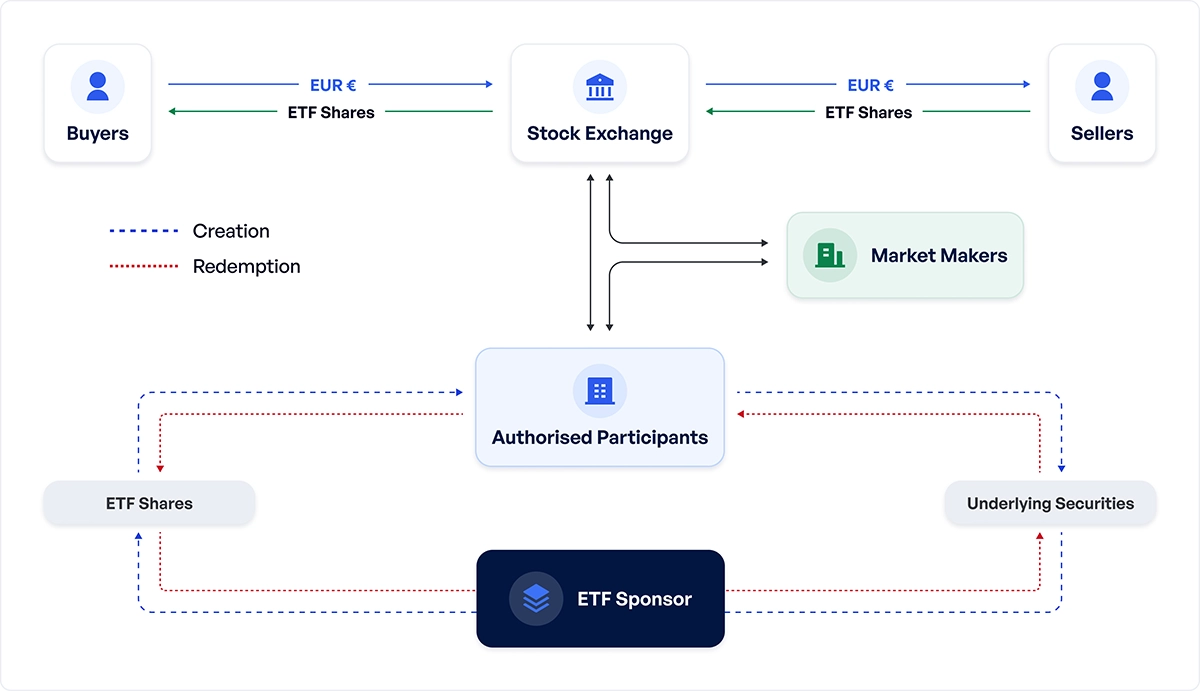
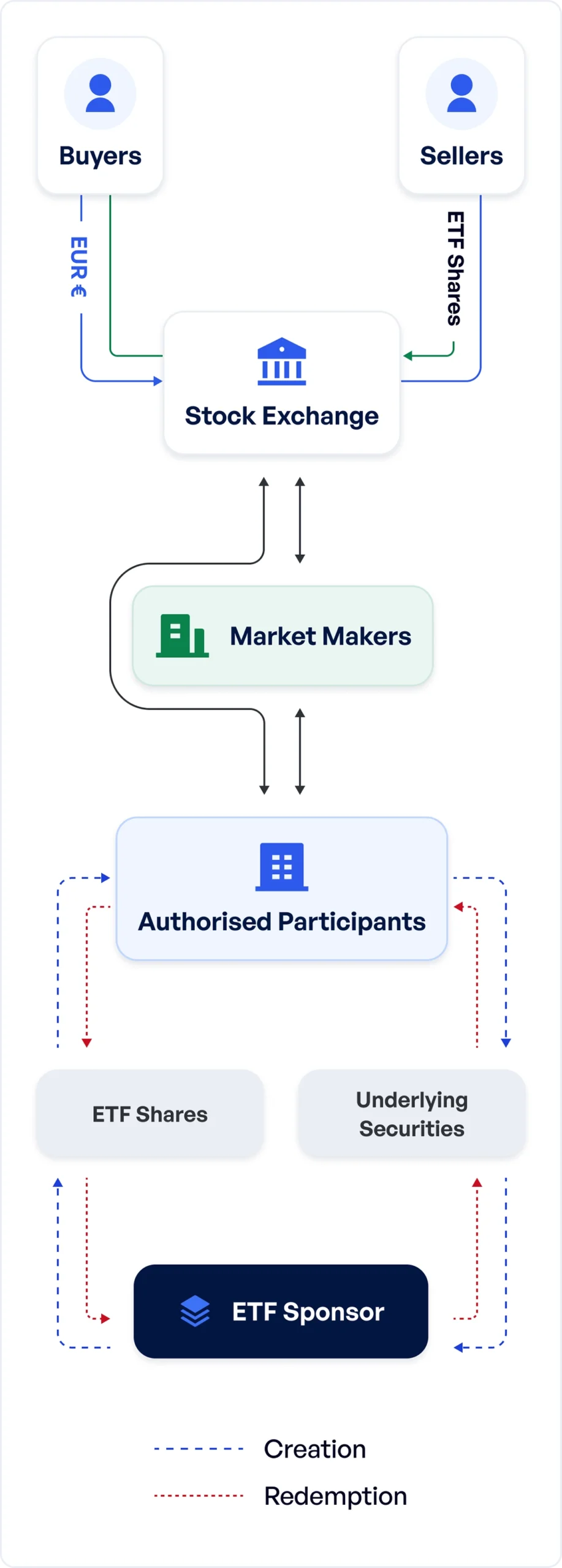
ETFs work in a 5 step process:
- 1An ETF sponsor, like Vanguard, sets up the fund, specifies the portfolio and signs an agreement with an Authorised Participant (AP), like Goldman Sachs.
- 2The AP purchases or sources the portfolio securities, transfers them to the ETF’s custodian and receives a fixed number of ETF shares in exchange. This is called a creation unit, and it usually consists of 50,000 shares.
- 3The AP sells the ETF’s shares to the public through a stock exchange or via a market maker. The shares represent a claim over the assets held by the custodian.
- 4Investors buy and sell the shares from each other on the secondary market.
- 5APs work with the ETF sponsor to create and redeem shares based on market demand.
Authorised Participants (APs)
Authorised Participants (APs) are financial institutions that have agreements with ETF sponsors that gives them the right, but not the obligation, to create and redeem ETF shares. The AP’s job is to adjust the number of ETF shares outstanding to keep the share price aligned with the value of the ETF’s underlying assets.
ETFs use an in-kind creation and redemption process for ETF shares that’s different to mutual funds. When you invest in a mutual fund, your money goes directly into the fund, and the fund manager uses it to buy more investments, like stocks and bonds. This is called a subscription. Likewise, when you cash in units in a mutual fund, the fund might need to sell investments to pay you. This is called a redemption.
When you buy an ETF, your money doesn’t go into the fund. Instead, you’re buying a claim over the ETF’s assets from another investor. If demand for an ETF’s shares exceeds the available supply, APs will work with the ETF provider to create new shares in three main ways:
- 1Providing a creation basket of securities to the ETF
- 2Giving the ETF cash equal to the value of the creation basket, plus trading costs
- 3Providing the ETF with cash equal to the value of the ETF shares, plus a bid-ask spread
The ETF sponsor will then deliver new shares in the ETF to the AP, who can then either sell them or hold them in their inventory. When the supply of ETF shares exceeds demand, an AP will exchange ETF shares – sourced from their inventory or by buying them – for a redemption basket, or cash, from the ETF sponsor. The exchanging of ETF shares for underlying assets is known as an in-kind (or in-specie) transfer.
Key Insight: In-kind or in-specie transfers allow ETFs to be more tax-efficient than mutual funds. For example, if there’s a redemption from the fund, the ETF can transfer appreciated assets to the AP in exchange for ETF shares, which are then destroyed. In-kind transfers don’t result in a charge to capital gains tax in many jurisdictions. Irish-domiciled ETFs are subject to the gross roll-up regime and aren’t liable to taxes on investment gains either way. To learn more about funds tax, check out our dedicated guide.
Market Makers
Market makers are financial institutions that quote both the bid and ask price of an asset, earning a small profit on the difference. They are liquidity providers – always there to buy from sellers and sell to buyers.
Key Insight: A financial institution can act as both an AP and a market maker at the same time. However, not all market makers are APs and not all APs are market makers.
How ETF Shares Are Priced
The price of one share in an ETF is based on the net asset value (NAV) per share of the fund, plus or minus the effects of market demand. That means an ETF’s market price can trade slightly above (a premium) or below (a discount) its NAV.
NAV per share = (Total ETF Assets - Total ETF Liabilities) ÷ ETF Shares Outstanding
The NAV per share represents the value of the assets backing each ETF share. If the ETF was liquidated and its assets were sold, shareholders would be entitled to receive the NAV per share after liabilities have been paid.
The value of your ETF shares will increase when the value of the ETF’s underlying investments increases. If the underlying investments fall in value, the ETF’s NAV will also fall. Unlike regular company shares, ETF stock prices usually stay close to its NAV because of ETF arbitrage.
ETF Arbitrage
ETF arbitrage is the process of profiting from temporary differences between an ETF’s share price and the value of its underlying assets. It’s what keeps an ETF trading close to its net asset value (NAV).
APs aren’t compensated by the ETF sponsor for their role in keeping the fund’s share price aligned with the NAV – but they have an economic incentive to do it anyway. There are two main ways that an AP can make money creating or redeeming ETF shares:
If the ETF share price is €100, but the ETF’s underlying assets are valued at €99, the fund is trading at a premium to NAV. The AP can profit by creating ETF shares – buying the basket assets for €99, exchanging them with the ETF issuer for new ETF shares and selling those shares for €100. The AP earns a profit of €1.
Buying the underlying assets increases demand for those securities, which may push their prices higher. Selling the newly created ETF shares increases the supply of ETF shares, putting downward pressure on the ETF share price. The arbitrage continues until the premium disappears.
If the ETF share price is €99, but the ETF’s underlying assets are valued at €100, the fund is trading at a discount to NAV. The AP can profit by redeeming ETF shares – buying ETF shares for €99, exchanging them with the ETF issuer for the basket assets and selling those assets for €100. The AP earns a profit of €1.
Buying the ETF shares increases demand for the ETF, which may push its share price higher. Selling the underlying assets may put downward pressure on the prices of those securities. The arbitrage continues until the discount disappears.
Key Insight: Where the AP and market maker are different entities, they may agree to share the profits from ETF arbitrage, or the market maker may pay the AP a fee to create or redeem ETF shares.
ETF Rebalancing
The ETF is responsible for managing the underlying securities, including portfolio rebalancing – not the AP. For example, an index ETF will need to rebalance its underlying assets to match the index weightings as they change over time. It does this by buying and selling shares within the basket. This process incurs transaction costs that aren’t accounted for in the TER.
Key Insight: ETF shareholders bear the cost of portfolio management and rebalancing, but APs bear the cost of creating and redeeming shares.
Exchange trade funds generate cash in a number of ways:
- Dividends or interest received from stocks, bonds or other assets. Distributing ETFs will pay this income out to shareholders, accumulating ETFs will reinvest it.
- Realised gains from selling investments.
- Securities lending revenue, where the ETF lends out a portion of the underlying assets to short-sellers for a fee. Some or all of the fee income will be shared with the fund.
- Swap spreads, specifically for synthetic ETFs. To learn more about synthetic ETFs, check out our complete guide.
Frequently Asked Questions
Inverse ETFs are designed to move in the opposite direction of a particular index or asset. For example, an inverse S&P 500 ETF will increase in value when the S&P 500 index declines. They are not suitable for beginners.
Leveraged ETFs aim to amplify the daily returns of an index. For example, an S&P 500 2x Leveraged UCITS ETF should gain 2% if the S&P 500 rises by 1% and vice versa for losses. UCITS ETFs that use leverage are limited to a ratio of 2:1 (i.e. 2x or 200%).
It depends on the fund. Most equity ETFs benchmark themselves against a Net Total Return (NTR) index rather than a Gross Total Return (GTR) index. NTR indices assume dividends are reinvested after withholding tax (DWHT). For example, the S&P 500 NTR index assumes DWHT of 30% – which is why many Irish-domiciled S&P 500 ETFs outperform the index.
Hedge funds are typically reserved for professional investors. They’re actively managed and come with higher management and performance fees than ETFs.
Yes, but only for hedging investment risks (i.e. euro-hedged share classes) and efficient portfolio management (i.e. synthetic ETFs).
An ETF ticker is the short code used to identify an ETF on a stock exchange. The same ETF may have multiple tickers because it trades on several exchanges, often in different currencies. That’s why it’s best to search for an ETF using its ISIN.
Securities lending is where an ETF temporarily lends some of its holdings to large financial institutions in exchange for a fee. This can help improve the fund’s returns. The borrower must provide collateral in case they fail to return the borrowed shares. The ETF can recall the loaned out securities at any time.
ETFs are the better option for long-term investors who want to earn the index return at a low cost. They come with no minimum investment, intraday trading, and greater transparency and accessibility through modern investment apps.
Irish retail investors can’t invest in US ETFs because of PRIIPs regulations. Under these rules, investment products sold to EU investors must provide a Key Information Document (KID). US ETF issuers don’t produce KIDs, so we can’t invest in them. Fortunately, there’s usually UCITS-equivalents of US ETFs available.
ETFs sponsors appoint APs based on their financial strength, trading expertise and their ability to create and redeem ETF shares efficiently. APs are typically large investment banks.
Both the total expense ratio and ongoing charges figure measure the annual cost of managing and operating the fund. In practice, they’re two ways of saying the same thing.
Two reasons: lower fees and the difficulties of active management. Index funds don’t need to employ an expensive team of professionals to select investments – this means investors keep more of their returns. Plus, consistently outperforming the market over decades after-fees is extremely challenging, if not impossible.
The best ETF for beginners is often the same as for experienced investors – a low-cost, global equity index fund that’s bought and held for decades.
There’s two ways. First, if the value of the ETF's underlying investments increases, the price of your shares will generally increase too. You can lock in this gain by selling. Second, the ETF might pay a dividend. Other ETFs will automatically reinvest their income, increasing the fund's value.
For most Irish investors, it’s best practice to buy a EUR share class listed in euros if one is available. That way, you’ll buy and sell and receive dividends in euros, avoiding unnecessary FX fees. If you want to eliminate currency risk, you’ll need to buy a EUR-hedged share class.
ETF liquidity is partly determined by trading volume and bid-ask spreads on stock exchanges. More important is the liquidity of the ETF’s underlying investments. Even with low trading volume, APs can easily create or redeem shares provided the assets are liquid.
An active ETF has a portfolio manager who decides which companies to buy and sell in an attempt to outperform the benchmark. A passive ETF bases its investment decisions on an index.
Compare ETFs Side by Side
Ready to choose an ETF? Compare the most popular ETFs available to Irish investors by index, fees, dividends, and more to find the right investment for your portfolio.