
How Ireland’s State Savings Work
State Savings Accounts
State Savings Accounts are a way to earn tax-free interest on your savings with the safety of a repayment guarantee that’s backed by the Irish government.
Reading time: 8 min
Last updated: March 31, 2026

Table of Contents:

Written by:
Dan Malone
What are Ireland State Savings?
State Savings is the brand name for the savings products offered by the Irish government, sometimes referred to as national state savings. These products are not the same as traditional savings accounts. The main difference is that, with State Savings, you’re lending money to the Irish government, not a bank.
The money that the government raises from these products adds to Ireland’s national debt. Irish households have more than €19 billion saved with the government, accounting for over 8% of the country’s total debt.
The Irish government must repay the money you’ve saved with these savings products since they are part of the national debt. The government has the same obligation to individuals, corporations and foreign nations that purchase Irish government bonds to help fund the country’s public spending.
It’s this obligation that makes Ireland State Savings a true risk-free savings option. Ireland has an AA credit rating from Standard & Poor’s - there is no doubt on the government’s ability to meet their repayment obligations.
Unlike the Deposit Guarantee Scheme, which protects deposits in traditional savings accounts up to €100,000, the Irish government guarantee that applies to State Savings has no monetary limit. This means you can save as much as permitted without fearing something going wrong.
Types of State Savings Products
There are four types of State Savings Products: Fixed Term Savings products, Prize Bonds, regular saving products and Deposit Accounts.
- 1National Solidarity Bonds: 10 year fixed term.
- 2Savings Certificates: 5 year fixed term.
- 3Savings Bonds: 3 year fixed term.
These products all operate similarly, with the length of the fixed term being the main difference. As they are fixed rate savings products, the Annual Equivalent Rate (AER) is guaranteed and cannot change until the end of the term.
Each product release has an ‘issue number’. For example, National Solidarity Bonds (Issue 9), Savings Certificates (Issue 25) and Savings Bonds (Issue 18). You can think of each issue as a new batch approved by the Minister for Finance. This is important because the maximum deposit is €120,000 per person per issue.
For example, maxing out at €120,000 in Issue 9 of the National Solidarity Bonds, means you must wait for Issue 10 to be released before depositing more into that specific product. You could however still save money in a Savings Certificate or Savings Bond, with the same principles applying to those product issues too. The minimum amount you can save in any fixed term product is €50.
Prize Bonds are the State savings equivalent of lottery tickets. Each Prize Bond costs €6.25, with a minimum investment of €25 (or four Prize Bonds), and a maximum investment of €250,000 per person.
Each Prize Bond is entered into a weekly draw with all the other Prize Bonds, for a chance (but not a guarantee) to win cash prizes ranging from €75 to €500,000.
The more Prize Bonds you own, the better your odds become. Winnings are tax free. Unlike lotto tickets, you can get your money back from a Prize Bond after 90 days of purchase if you want.
For more information on prize bonds, how they work and whether they’re worthwhile, check out our blog.
These State Savings products are designed to encourage a period of regular monthly saving, which is then followed by a lump sum deposit.
There are two types offered by Ireland State Savings:
- 1Instalment Savings: 12 months regular saving, followed by a 5 year fixed term.
- 2Childcare Plus: 12 months of direct child benefit saving, followed by a 5 year fixed term.
Product Mechanics:
- You save money every month and, after 12 months, the total amount gets deposited into a 5-year fixed term account.
- You can save as little as €25 per month or as much as €1,000. If you want to continue saving after 12 months, you can do so through a fresh plan.
Childcare Plus Specifics:
- With Childcare Plus, you’re making a direct monthly payment of child benefit. This product requires you to be receiving Child Benefit (i.e., having a child under 16, or 19 if in full-time education/training or have a disability).
- If you save more than €12,000 in a year, the excess will be transferred to a Childcare Save account, which is a variable interest rate deposit account subject to Deposit Interest Retention Tax (DIRT).
Withdrawal Rules:
- Up to €3,000 can be withdrawn daily on demand from any An Post Office.
- Withdrawals larger than €3,000 require 7 days’ notice to be given.
Deposit Limits & Rate:
- There is no minimum deposit.
- The maximum amount you can save overall is €250,000 per person (or €5,000,000 for businesses).
- The AER on these accounts is variable, (meaning it can go up or down).
- The interest earned will be liable to Deposit Interest Retention Tax (DIRT).
How State Savings Work in Ireland
The biggest difference between the fixed rate products offered by State Savings and fixed rate savings accounts offered by banks is that your money is always fully accessible with State Savings. However, there’s a catch.
To earn the advertised AER for each Irish State Savings product, you need to leave your money saved until the fixed term ends. If you withdraw early, a lower AER will apply.
The government achieves this by applying a higher gross interest rate to your savings for every year that you keep them saved. Take €1,000 saved in a 3-year Savings Bond with an advertised AER of 1.32% as an example:
The True AER If You Exit Early
For example, if you held a bond worth €1,000 with an advertised AER of 1.32%:
| Term | AER | Gross Interest | Your Savings |
|---|---|---|---|
| Year 1 | 0.00% | 0.00% | €1,000 |
| Year 2 | 1.00% | 2.00% | €1,020 |
| Year 3 | 1.32% | 4.00% | €1,040 |
Table Source: State Savings
- If you withdrew after one year, you’d get your deposit back with no interest (a 0% AER).
- If you withdrew after two years, you’d get €20 worth of interest. That’s the same as having earned €10 in year one and €10 year two, or, an AER of 1.00%.
- If you saved until the end of the term, you’d get €40 worth of interest. That’s €13.33 each year, or, the full, advertised AER of 1.32%.
When you compare fixed rate State Savings products with instant access to other fixed term savings accounts, remember that you’ll only get the advertised State Savings AER if you keep your money in until the end of term. If you withdraw earlier, your AER will be lower. You must compare apples with apples.
These rules apply to both Fixed Term and Regular State Savings products.
State Savings Interest Rates (2026)
In order to choose the best State Savings products and interest rates, you need to be aware of all of the options available.
You can compare Ireland State Savings products to find the best rates by using our comparison tool.
How to Open and Manage a State Savings Account
To start saving with Ireland State Savings you’ll need to:
- 1
Complete the application form and provide certified copies of proof of identity, proof of address, proof of PPSN and proof of guardianship where the applicant is under 18.
- 2
Bring the completed application form to your local Post Office.
- 3
Once approved, you’ll receive your registration details including your State Savings Customer Number (SSCN).
- 4
Use your SSCN to deposit in one or more State Savings products.
Every State Savings product, except deposit accounts, can be managed through Ireland State Savings Online.
An Post & NTMA: Who Manages State Savings?
The National Treasury Management Agency (NTMA) manages Ireland State Savings on behalf of the Minister for Finance. The NTMA is also responsible for managing Ireland’s national debt.
An Post handles the sale and administration of State Savings products on behalf of the NTMA, with the exception of Prize Bonds which are handled by the Prize Bond Company.
State Savings vs. Bank Savings Accounts
It’s important to understand the ways in which State Savings differ from traditional bank savings accounts:
| State Savings | Bank Savings Accounts | |
|---|---|---|
| Deposit Guarantee Scheme | No | Yes |
| Unconditional Government Guarantee | Yes | No |
| Tax-Free | Yes, except Deposit Accounts | No |
| No Fees or Charges | Yes | Not always |
| Interest Rate Type | Fixed and variable | Fixed and variable |
| Access to Funds | Instant or Notice Access | Instant, Notice or No Access |
Ireland State Savings Frequently Asked Questions
Yes, State Savings products are tax-free. This means any income and gains you make from your State Savings deposits are free from tax. The only exceptions are State Savings deposit accounts and childcare save accounts. Both are subject to Deposit Interest Retention Tax (DIRT) at the current rate of 33%.
Yes, State Savings are perfectly safe. All savings are fully backed by a promise from the Irish government to repay without limit.
Irish State Savings interest rates can be either fixed or variable, depending on the product. The rate that you receive will depend on how long you keep saving.
No, Prize Bonds don’t pay interest, they pay lottery-styled cash prizes. To learn more about your chances of winning each prize, you can try out our state savings calculator.
No, there are no fees, charges, or commissions on State Savings products.
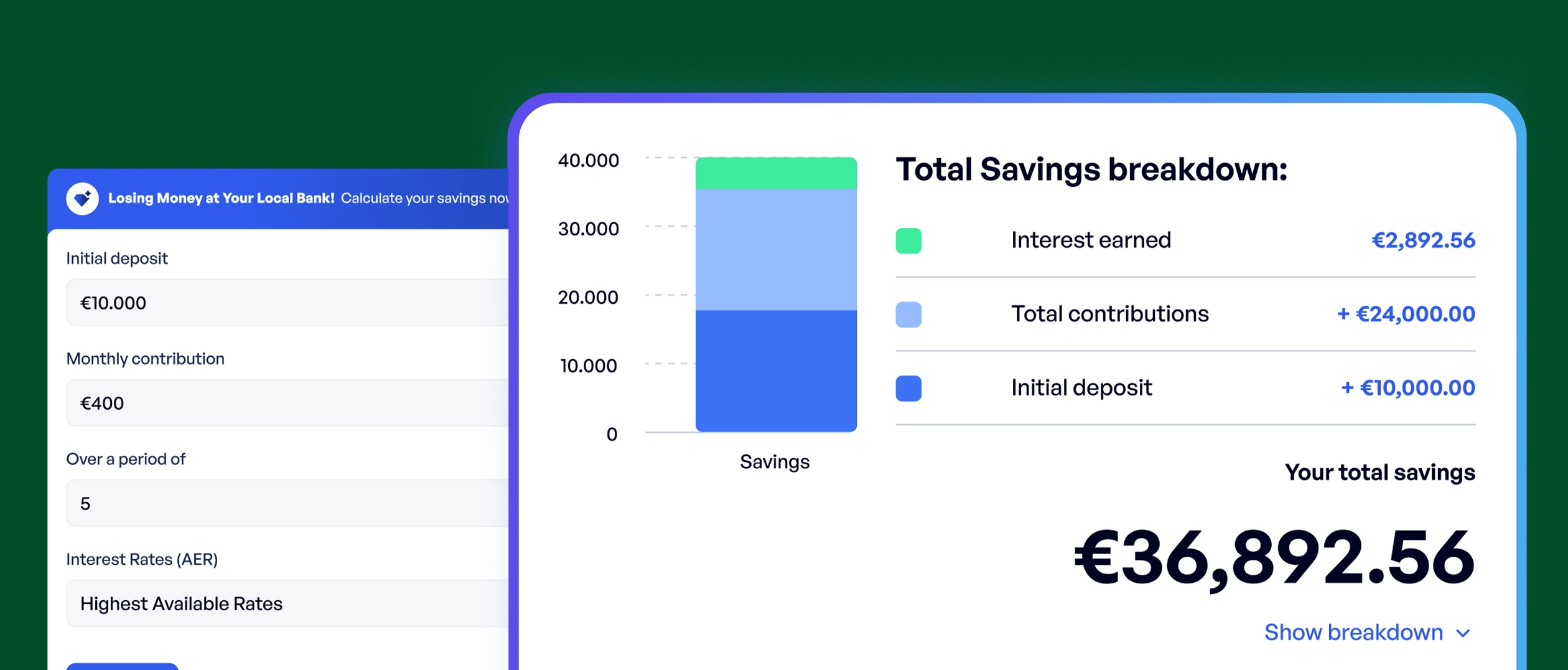
Savings Calculator
Calculate how much you can save over time, and get matched with the best accounts.
Savings Comparison Tool
Compare 265+ savings accounts side-by-side for detailed analysis.